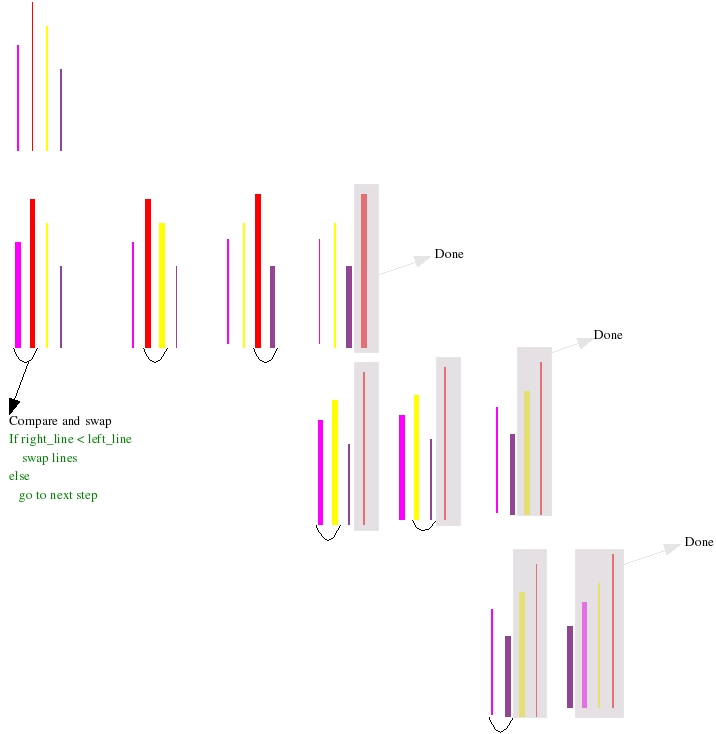
This is a simple, but quite inefficient algorithm to sort an array of objects (numbers). The basic idea is to compare two neighboring objects, and to swap them if they are in the wrong order.
Given an array a[] of
numbers, with length n, the main part of a bubble sort
algorithm looks like:
for (i=0; i<n-1; i++) {
  for (j=0; j<n-1-i; j++)
    if (a[j+1] < a[j]) {  /* compare the two neighbors */
      tmp = a[j];         /* swap a[j] and a[j+1]      */
      a[j] = a[j+1];
      a[j+1] = tmp;
  }
}
The algorithm consists of two nested loops. The index j
in the inner loop travels up the array, comparing adjacent entries in
the array (at j and j+1), while the outer
loop causes the inner loop to make repeated passes through the array.
After the first pass, the largest element is guaranteed to be at the
end of the array, after the second pass, the second largest element
is in position, and so on. That is why the upper bound in the inner
loop (n-1-i) decreases with each pass: we don't have
to re-visit the end of the array.
The first step in the algorithm takes n-1 comparisons. The second
step takes n-2 comparisons, and so on. The last step takes one
comparison. The total number of comparisons then
is
1+2+...+n-1=n*(n-1)/2, which is O(n^2).